
I know nothing about primate anthropology, but I did know a primate anthropologist. She took me into the rainforests of southern Uganda, where we spent several afternoons lurking in the shrubbery and watching a troop of chimpanzees. When we got too close to the mothers and babies, the males chimped out. They got up on their hind legs, bared their teeth, howled like extras from Tarzan, and started bounding toward us. To avoid a savaging, we mimicked subordinate chimpanzee behavior. This requires no scientific expertise, though experience of male pattern baldness may help. You look down in shame and repeatedly stroke your pate from back to front as though trying to glue down the strands of a combover in a high wind. If that doesn’t work, run your other hand over your eyes and nose as though wiping that smirk off your simian face before you make one of the alphas come down there and do it for you.
The chimpanzees relented and went back to eating fleas off each other’s heads. Their response to our subordinate grooming suggests that chimps think humans are part of their family, and perhaps that they think I am a lesser kind of chimp. That I was in the middle of Uganda pretending to be a bald monkey to preempt being bitten in the face suggests I believed the same about our consanguinity, but also that, by dint of getting there and presuming to intrude into their bosky bower, I consider myself to be a superior kind of chimp. Our consanguinity is the cornerstone of Darwinian evolution, even though Darwin himself was wary of going what he called “the whole Orang.” But what does “family” mean here? Like those surprise and distant relationships that self-swabbers discover from genealogy testers such as 23andMe, once your cousinhood gets beyond the fifth and sixth degree, you’re related to everyone, even Genghis Khan.
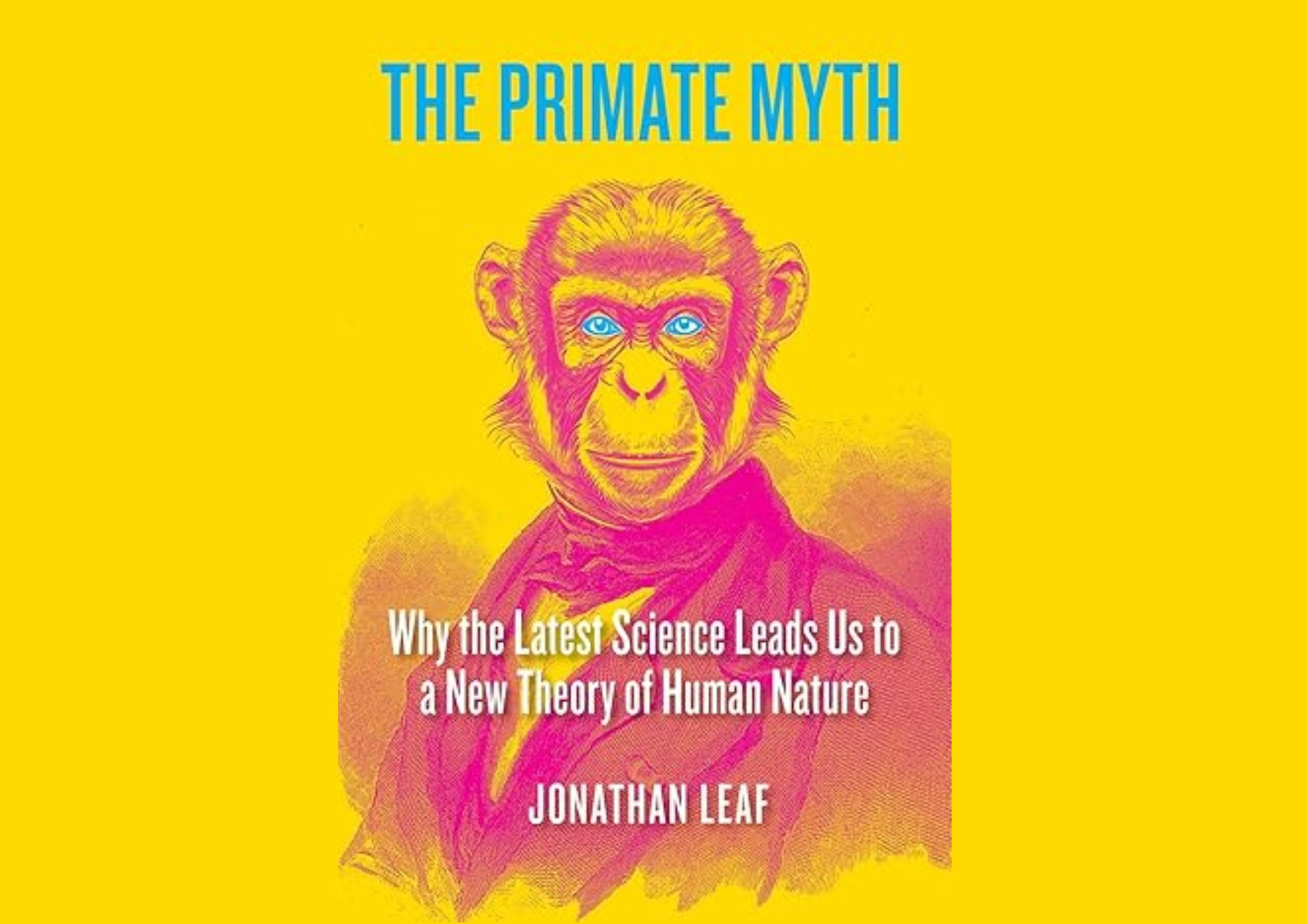
The surprise in Jonathan Leaf’s The Primate Myth is that our relationship to the apes may be more distant than we think. The stakes are higher than when we play a round of Six Degrees of Kevin Bacon. If we are closest to the apes above all creatures, then we must, the evolutionary logic goes, look back down our evolutionary track and find our image in theirs, not least because Darwin’s children insist that we are not going to find it in religion. Hence the search for our better nature in the more appealing aspects of chimp life: their resemblances of physiognomy, their ability to drink tea from cups and saucers, the male gorilla’s custom of alleviating the boredom of an afternoon at the zoo by publicly masturbating and throwing feces at the glass.
If, however, we are behaviorally closer to other creatures, then we might look sideways at a gallery of models who developed on parallel evolutionary tracks. This, Leaf argues, would allow us to develop a species self-image that would be more accurate. It would be good for science, and also good for us. Apart from enlivening the longueurs between our flea-grooming sessions, it would free us from the narrow notion that we are “apes wearing collared shirts,” and the attendant delusions that certain kinds of behavior are justifiable because they are true to our evolution. As Leaf’s skillful and well-sourced exploration of recent research shows, the truth about our evolutionary legacy is more complicated than we assume. As with all one-way journeys, where we are now may be more relevant to us than our point of origin.
Evolution, Leaf writes, does not resemble the popular cartoon of the “Ascent of Man,” which goes from a crouching ape to a standing one, and then an early hominid and Homo sapiens:
Dinosaurs led to birds, but they are also the ancestors of reptiles. The notion that humans should be like apes is based on a misunderstanding of evolution. Animals don’t display similar traits or behaviors because they have common ancestry but because they have the same evolutionary needs.
To think of us as primates is, Leaf writes, akin to driving past an airport, taking a quick look and assuming that the terminal is “a giant parking lot.” Humans may resemble chimps, but we did not evolve as they did to be tree-dwelling herbivores. If, as scientists say, our genome resembles a chimp’s more than a chimp’s resembles a gorilla, that is because gorillas and chimps diverged before chimps and humans. The Primate Myth is not an attack on evolutionary theory: Leaf affirms that we share more than 90 percent of our DNA with chimps. It is a refinement of the kind that the scientific method is supposed to encourage, and a call for what Thomas Kuhn called a “paradigm shift.”
In The Structure of Scientific Revolutions (1962), Kuhn showed how scientific paradigms formed into “normal science,” and then broke down as new research discovered anomalies and researchers identified professional opportunities in reexamining their assumptions. Leaf identifies a catalog of anomalies, but also a lack of professional incentives for a paradigm shift.
The chimp lobby has used human descent from apes to affirm that human behavior is ape-like. Its affirmations have always reflected political priorities. When On the Origin of Species appeared in 1859, Karl Marx detected a familial resemblance between the mechanisms of Darwin’s theory, competition and specialization, and the values of the progressive middle class from which Darwin came: “It is remarkable how Darwin recognizes among beasts and plants his English society, with its division of labor, competition, opening up of new markets, ‘inventions’ and the Malthusian ‘struggle for existence’ … in Darwin the animal kingdom appears bourgeois.”
The Darwinists were less liberal than Darwin. By the end of the 19th century, Darwinian descent meant racial theory, natural selection meant eugenics, and Nietzsche, despite only having read a second-hand summary of Darwin in German, was on his way to posthumous acclaim as a Darwinian anthropologist of permanent war. The resulting disaster discredited Social Darwinism, at least in the Western democracies. After 1945, evolutionary theory was caged in sociology, a demystifying discipline whose founder, Darwin’s contemporary Auguste Comte, intended it to put the therapeutic and organizing functions of religion on a rational footing.
When liberal society demanded an egalitarian, pacific compassionate human nature, primate anthropologists such as Jane Goodall supplied the raw material, and popular culture polished up the desired image. By the 1970s, scientists were teaching chimps to understand English, Planet of the Apes was on TV every Saturday morning, and sentimentalists were adopting chimp babies and getting their faces bitten off because they didn’t know the bald subordinate routine.
Leaf does not doubt the scientific consensus that chimpanzees and humans share traits. They and we use tools, display emotions, form social bonds, teach skills to our young, and form war parties to smash our rivals’ heads in with rocks. What Leaf doubts is the weight that the scientific consensus grants to these similarities. He presents a pile of recent research showing that we do not share many key traits with chimps—but we do share them with other mammals.
Chimps may be violent and sex-mad, but they are poor communicators. Dogs, dolphins, and some species of whales are cooperative hunters like us, but apes are more effective when hunting in packs than alone. We have flat nails like the apes and we can also climb trees, but apes do it better because they have prehensile feet and we do not. They are not herd animals, but we are. We have altruism, and so do dogs, but apes lack it. They build nests and live in trees. They eat little meat. They sleep far more than we do. They are “equatorial, forest-dwelling, herbivorous, tree-climbing knuckle-walkers who lack skills of speech and cooperativeness,” but most of us humans aren’t. It’s enough to drive you bananas.
Primate anthropologists, Leaf argues, have climbed up a tree and their professional dignity prevents them from climbing down and shifting their paradigm. The great apes are greater at being apes than we are, but our evolutionary development means that we are more like other species in key regards. Rats and dogs are faster learners than chimps and chickens. Dogs and dolphins laugh. Wolves, dogs, hyenas, elephants, and crows can all work together to pull on a strap in order to get a reward. The survival of a parent is more important for young whales and dolphins than for young chimps. A border collie can learn up to 1,000 words. Chimps struggle to learn 250 words, and they are slower learners. Then again, English tabloid newspapers have a core vocabulary of about 300 words, and the readers still get to vote.
Chimp homosexuality is, as in prison and the navy, a “means to prevent conflict” by “establishing hierarchy, preventing conflict, and defusing tension.” Plenty of other large-brained, herd-forming mammals exhibit “preferential homosexual ties” like this, including bottlenose dolphins, elephants, giraffes, and bison, but sheep and humans are the only mammals to express “exclusive homosexual attraction.” Twenty-two species of bats have been observed committing homosexual acts in the Wilde, and while bats are not herd animals like us, they are, like us, great vocalizers.
The evolutionary drives that made us what we are represent “a radical divergence away from a primate nature.” The drivers, Leaf argues, advanced on language and sociability, and not only because research suggests that “gay men tend to have a larger anterior cingulate gyrus and an expanded left occipito-temporal cortex,” which is the part of the brain that activates when we form words into lexical patterns. Apes use oral expression for “conveying threats and fending off competition.” Language creates abstract reasoning and complex social expressions such as religion and art. The most distinctive human behaviors could not exist without language: religious sacrifice, fashion trends, sports, preferential homosexuality, ostracism and slavery, nationalism, the veneration of priestly celibacy and monogamous mating.
If man is the speaking animal, then our real fellow-travelers on the evolutionary road are the chatty, clever cetaceans, the whales and the dolphins. Ultimately, however, Leaf believes that, like Charlton Heston at the close of Planet of the Apes, we must accept that we are alone. Leaf recommends that we reassign ourselves from the primate order to a “distinct family grouping,” or even a separate order, Homo. This has happened before. The primate order has five species, but for almost half a century, it had six. Tree shrews, native to South America, were recently reclassified in a separate order, Scandentia. They have prehensile feet like apes (and unlike us). But they have claws, not nails. Then again, they resemble us in being largely monogamous, with the male and female sometimes sleeping in separate nests. Does the male tree shrew snore?
The Primate Myth: Why the Latest Science Leads Us to a New Theory of Human Nature
by Jonathan Leaf
Bombardier Books, 320 pp., $21
Dominic Green is a Wall Street Journal contributor and a fellow of the Royal Historical Society.