
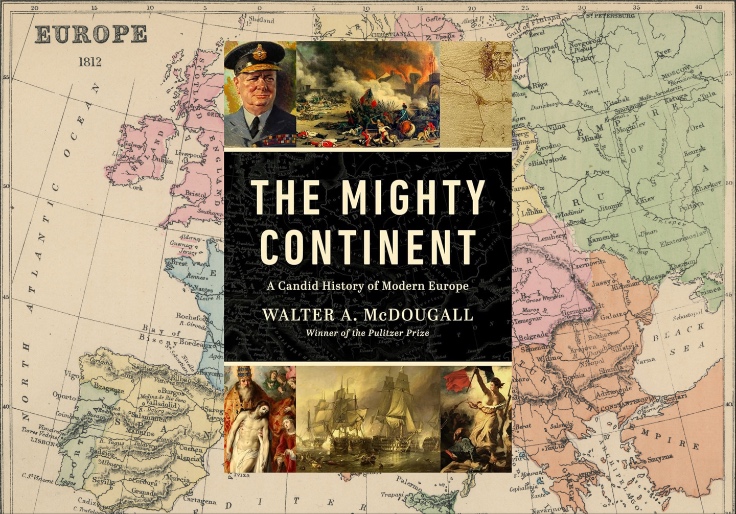
“Too often academic treatises these days are insufferably ‘woke’ or even unreadable, thanks to their postmodern jargon,” explains the author of this refreshingly countercultural work. “This book, by contrast, consists of old-fashioned, meat-and-potatoes history.” After lecturing on European history at UC Berkeley and Penn, Professor Walter McDougall is clearly exasperated at the way his craft has been wrecked by what he lists as “postmodernism, deconstructionism, critical race theory, radical feminism, and ‘wokeness’ in general.”
Instead of merely ranting against those ideologies, however, he has shown what can be achieved if historians simply ignore them. Drawing on his half-century of lectures, he has written a history of Europe from the Renaissance to 1945 that is erudite, thought-provoking, and engaging, proving that sweeping surveys of the past can still be written in the grand old style. This book is a triumphant return to proper history, the way it was written before the commanding heights of the Academy were captured by the Left. It’s so old-fashioned that there are no endnotes or bibliography, but is none the worse for that.
Professor McDougall expertly covers half a millennium of great movements, revolutions, and wars with a deft touch, and the underlying belief—cue shock, horror, and pearl-clutching from the Left—that “Europeans invented the modern world.” He tells the remarkable tale of the Renaissance, and Protestant and Catholic Reformations, imperialism, Louis XIV’s absolutism, the decline of magic and rise of science, British parliamentary evolution, the Scottish and French Enlightenments, more imperialism, the (highly contrasting) American and French Revolutions, the Napoleonic Wars, the Industrial Revolution, the rise of Bolshevism and Fascism, and the horrors of the two world wars. Somehow, he manages to do this intelligently and accurately in only 422 pages.
This is how all history should be written, but as Professor Herbert Butterfield, quoted here, once wrote, “The study of the past with one eye upon the present is the sources of all sins and sophistries in history.” McDougall does not for a moment underplay the dark side of European history—the nearly constant warfare, imperialism, racism, and social oppression—but as he points out in an inspiring preface, despite all that, educators used to tell the truth of “Europeans and their overseas descendants as leaders in humanity’s grand march of progress.” Brave words in today’s Academy, yet no more than one would expect from a Vietnam veteran who taught at Berkeley in the 1970s and thus has survived the brickbats.
McDougall is almost 80 years old, and, as he points out, 60 years ago he was taught “Western Civ,” as it was then called, in a way that unashamedly “celebrated those persons and nations who had invented, defended, and spread such ideas and institutions as limited government, the rule of law, religious liberty, popular sovereignty, capitalist economics, industrialization, and the unprecedented prosperity to which they gave rise.” It is hard to imagine many young scholars in today’s Academy being quite so brave in making such a (true) statement today about the benefits given the world by the West. Instead, all too many of today’s educators seem to think their role is to tear down those very ideas and institutions.
Although there is a short coda bringing the story up to the present day, it is instructive that McDougall ends his book with the German surrender in May 1945. “With that event,” he argues provocatively, “European history, strictly speaking, came to an end.” He means its logical rather than its chronological conclusion, of course. This was not just because Eastern Europe became dependant on Russia and Western Europe on America, but also because, he contends, the idea of European Enlightenment died at Auschwitz.
He admits it is a “chilling claim,” but concludes that by 1945 it was necessary “to jettison those pleasant Enlightenment myths to the effect that human nature is benign, people are rational, and history is a story of progress. The medieval was for centuries supposed to have been the era when Europeans were cruel, violent, poor, ignorant, and superstitious. But compare that era now, with eyes wide open, to the conditions that prevailed in our postwar era.”
McDougall notes the essential role of the Second World War in the invention of radar, the automatic calculating machine, rocketry, and the nuclear warhead. Collate them and you have the doomsday weapons that can destroy all life on the planet. Meanwhile, Europeans have to face the fact that they have “witnessed their own global hegemony self-destruct in the course of a single generation.” The title of the book is thus intended as a description of an earlier, pre-1914 era of European history, not as a summation of the paltry European Union-dominated continent of today.
The book is subtitled “A candid history of Modern Europe,” and the author is indeed refreshingly candid about areas of the past that are often downplayed because they contain uncomfortable truths, especially for the political Left. “Is it not customary to think of fascism as an extreme right wing movement, the very opposite of communism on the exteme left?” he asks. “Indeed, but the reason it became customary to imagine fascism and communism as opposites was the propaganda of the fascist and communist regimes, which boasted of being the other’s bitterest enemy in order to exploit their people’s fear and to justify the oppression that both imposed on their people.”
In fact, Nazism was always a creed of the Left; the clue was in the name National Socialist German Workers’ Party. The reason it is always shortened to Nazi is not just for editorial ease: It erases the giveaway words “Socialist” and “Workers” in the party’s title. This book is excellent on the similarities not just in the methods of the Nazi and Soviet regimes, but also in their underlying ideologies.
McDougall is also admirably clear-eyed about the problems facing the West today. “Europeans (and most Americans) no longer reproduce themselves,” he writes. “Few people today read Greek and Latin classics, even in translation. Few people today listen to the music of giants such as Bach, Mozart, Beethoven, and Brahms. Few people today meditate on the Bible or ponder the moral depths of authors like Dante and Dostoyevsky. Even highly educated people waste hours each day staring at computer screens, playing video games, and scanning social media. The printed book is going extinct. Artificial intelligence is making quantum leaps forward every year. Perhaps our future will indeed belong to the robots.”
Not all is lost, however. McDougall argues that by concentrating once again on the three greatest gifts that European civilization gave the world—the scientific method, the rule of law, and Judeo-Christian religion—we could possibly get out of our present predicament, even though all three are coming under increasing threat, from within and without. Although he quotes Alexander Solzhenitsyn’s Harvard address of 1978, which concluded that “no one on earth today has any way left to go, except upward,” in fact the implication of this scholarly, highly readable, but profoundly pessimistic book is that there’s a long way further we can go downhill if we don’t soon return to our three core values, the USP of Western Civilization.
So put on the Beethoven, open The Brothers Karamazov, and enjoy your meat and potatoes.
The Mighty Continent: A Candid History of Modern Europe
by Walter A. McDougall
Creed & Culture, 466 pp., $38
Andrew Roberts is the author of the upcoming Napoleon and His Marshals: Victory, Rivalry, Betrayal (Avid Reader Press/Simon & Schuster, October 2026) and a member of the House of Lords.