
“Once upon a time, I was meandering down the road of life with my husband, Jon. It was a regular and beige life, and it worked. It was a warm beige. We felt, and were, blessed and lucky. Normal.
“Suddenly, one day, while walking along our way, a metaphorical 18-wheeler semitruck hit us from behind and broke every bone in our bodies. All 412 of our combined bones were fractured, our spirits were mangled, and our hearts were stolen. Our life was stolen.
“That day was October 7th, 2023.”
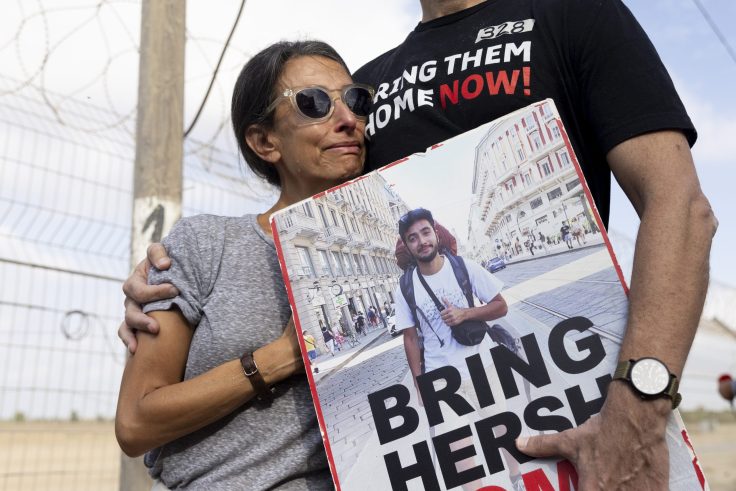
So begins the soul-searing memoir by Rachel Goldberg-Polin, the Chicago-born American-Israeli whose globe-trotting efforts to free her son Hersh from Hamas captivity ended when he was murdered in a tunnel in Gaza 330 days after his kidnapping.
When We See You Again is a book no parent should ever have to write but every American should read. That every Israeli will read it I take as given, considering the prominence of Hersh in the country’s national consciousness and the fact that posters pleading for his release still cling stubbornly to street signs across the world’s only Jewish state.
The book is an attempt by a bereaved mother, beloved by the millions of people across the globe who read and watched her and her husband’s efforts on behalf of their only son, to capture Hersh’s personality beyond the headlines and psychologically work through her unimaginable grief. “Since my heart is shattered into tiny pieces,” she writes, “it is easier to share than when it was one mighty, solid, and strong heart. So please take a shard. Be careful, they are sharp.” Its brilliance lies in the author’s weaving of unending loss and boundless frustration alongside attempts to find measures of comfort through Jewish teachings (by profession, she is an educator). Additionally wise is her avoidance of distracting the reader with partisan politics. No political figure in America or Israel is mentioned by name and she does not take a side on the debate that roiled the global Jewish community as to whether imprisoned terrorists should be freed in exchange for civilian hostages.
The reader is reminded of Hamas’s brutality, often absent from daily headlines about Middle East negotiations and by those who would seek a Palestinian state. Describing how Israeli authorities found the bodies of Hersh and his fellow murdered captives, she unsparingly and clinically notes, “They were all skeletal, filthy (the coroner estimated they had not bathed in months), bearing scars of torture, and riddled with close-range bullet wounds. Hersh had six. And his hair was covered in gunpowder.” She details how Chaim Peri, an 80-year-old peace activist, was kidnapped and murdered after 100 days of captivity. While Goldberg-Polin doesn’t dwell on every horrific detail, it’s worth reminding readers that on the 7th, Hamas also killed Holocaust survivors, burned Jews alive in their homes, sexually abused both living and dead victims, and livestreamed the murder of grandmothers on Facebook. Forty-six Americans had their lives snuffed out that day.
Stylistically, the book is framed through enjoying The Before (that is, before the 7th) and navigating all that came after, The End. Thus, in recalling the last night she saw her son alive, Goldberg-Polin describes:
At 11:00 P.M., Hersh leaned over me from behind and said, “I’m going to meet Aner.” He kissed me on my right cheek. Right here. Then he kissed Jon. He hugged Jen and said thank you. He turned around in the doorway, glanced casually at me, and said, “Love you, see you tomorrow.”
And he walked out of The Before. And I never saw him again.
It was the end of The Before.
And it was the beginning of The After.
But I didn’t know it then. I would be the fool.
For nine more hours and twenty-three minutes I would think I was still me,
and we were still us,
and all was still still.
But no.
It was
The End.
Those who sought, and failed to help her, are Very Important Men, elite in titles and impotent when it comes to saving her son. One time, on a Zoom call with the unnamed president (Biden) alongside other families of American hostages, she recalls “watching the little diorama boxes as one woman got up and left her room for two or three minutes. I remember her coming back and unmuting, interrupting the president and screaming, ‘They just found my second daughter! They are both dead! My two daughters are dead!’ She sounded like her limbs were being torn off. We all started crying and screaming. A wave of horror, on mute. The president put his head into his hands on his desk and wept, shoulders heaving up and down.”
This was, of course, before Rachel and Jon spoke at the Democratic National Convention, days after which Hersh was murdered, to which that party and the Biden administration responded to the cold-blooded killing of an American in an underground terror tunnel by doing… nothing. Months later, the outgoing President Biden was seemingly expressing sympathy for the side of the terrorists, photographed holding a book by the virulently anti-Israel Columbia professor Rashid Khalidi.
Contrasted with the purposely hazy unhelpful figures, is of course, Rachel’s beloved son, vibrantly painted throughout. A lanky lover of books, travel, and music, Hersh was a music festival aficionado, wore a Chicago White Sox cap often despite his father’s preference for the Cubs, carried his mother’s bag to synagogue, and annoyingly teased his two sisters as brothers do. Bearing awful pain (Hersh’s dominant left hand was blown off by a grenade before he was seized by his captors), he somehow survived 11 months in conditions that it is inconceivable any human was held in in this century.
There was no happy ending for Hersh, nor is there comfort on the horizon for his family. But Rachel insists on enduring, as do the Jewish people.
Toward the end of the book, Goldberg-Polin writes:
I think back to Moses in the Torah at the end of Deuteronomy, chapter 30. He is preparing the Children of Israel to enter the Promised Land without him. Moses is downcast and frustrated that his destiny is not to enter that place he has so longed for. It seems mean that he cannot go in with all the others. But it was not the plan for him.
Moses tells the people they have a real decision to make. The path they choose can be for life or for death. And like a parent not wanting their child to make a decision from which there is no going back, Moses exhorts the nation, “Choose life!”
I want Moses here, shouting at me to choose life. Coaxing me in the right direction when I’m feeling lost. I’m straining my ears listening. Instructions, please.
When We See You Again
by Rachel Goldberg-Polin
Random House, 288 pp., $30
Stuart Halpern, senior adviser to the provost and deputy director of the Straus Center for Torah and Western Thought at Yeshiva University, is the author, with Wilfred M. McClay, of Jewish Roots of American Liberty: The Impact of Hebraic Ideas on the American Story (Encounter).