
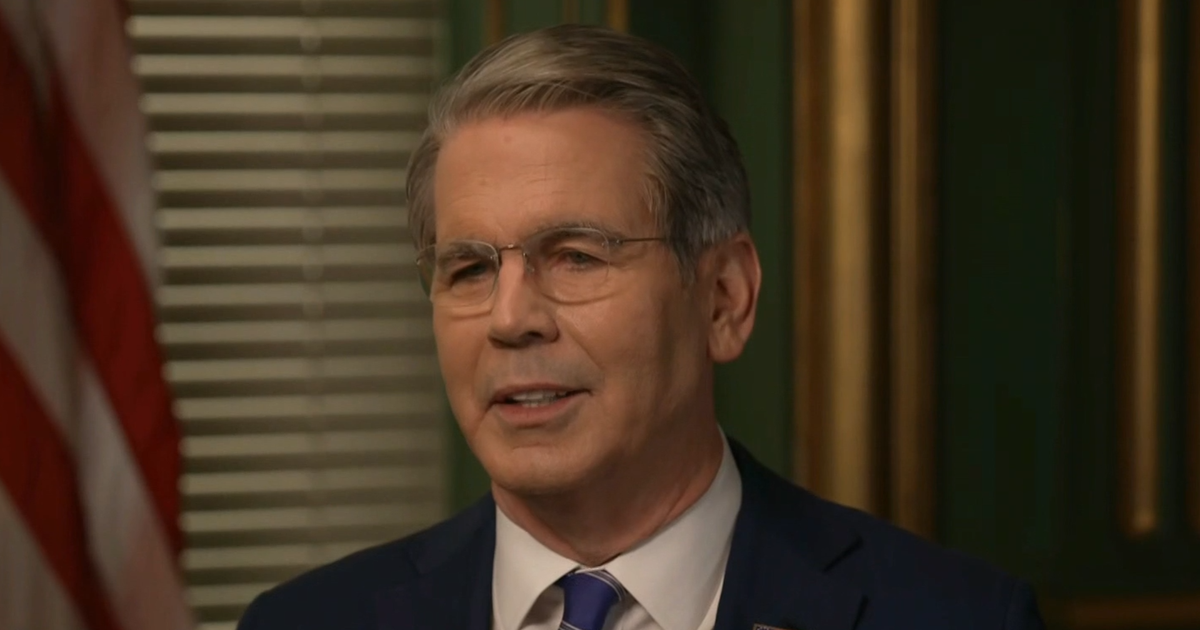
U.S. Treasury Secretary Scott Bessent addressed his department’s ongoing investigation into Federal Reserve Chair Jerome Powell and the administration’s new $1,000 “Trump Accounts” for children born during President Trump’s second term in an interview Wednesday with “CBS Saturday Morning” co-host Kelly O’Grady. Read the full transcript of their conversation below.
KELLY O’GRADY: Thank you so much, Secretary, for sitting down with us. I want to start on the Trump accounts. Okay? So let’s start broad and quick. What, for families viewing, is your one-sentence pitch on the Trump accounts?
SECRETARY SCOTT BESSENT: Well, for the families who have children between January 1st, 2025, and December 31, 2028, you got $1,000 coming from the government that’s going to be invested into an index fund. But for all families with children below age 18, sign up, Trumpaccounts.gov, they’re going to go live July 5th. So even if your child doesn’t get the thousand dollars from the government, you can contribute in tax free. And we’re going to have employers who are contributing, friends, family can contribute. We got some of America’s great philanthropists like Michael and Susan Dell, $6.25 billion, you got Ray Dalio, who adopted children, or sponsoring children in the state of Connecticut, Brad Gerstner, who, this really came from an idea at his dining room table, just announced he’s going to donate to all children below age five. So we think there are 25 million households who are there to sign up, we’ve gotten 600,000 signups just this week, so sign up, and the – start the program.
O’GRADY: All right. That might have been more than one sentence, but I’ll let it slide because it was good. It was a good explanation, I like it. I want to press you, though on this, this question of the wealth gap, because we’ve heard from critics that, well, let’s say I’m a high-income-earning family, I can keep contributing to that over time as my child grows. But if I’m a low-income family, my child, when they turn 18, may only have $5,000 or so, give or take. So, how are you going to prevent the wealth gap from widening with this program?
BESSENT: Well, actually, I think that that is a terrible criticism, and it shows how out of touch anyone who says that is, because if they say only $5,000, these are families, huge number of families in America, wouldn’t have $500 to meet a medical emergency. So how can they say only $5,000? What the hell are they talking about? Doesn’t make any sense. You know, it’s just because President Trump has sponsored it. They don’t agree with it. The other thing, too, is a lot of the contributions, Michael and Susan Dell’s contribution, $6.25 billion across America, is not going to the top 20% economic zip codes. So philanthropists can actually choose. They can choose by zip codes. They can choose by school district. They can do it by economic quintiles. States can get in on the action. So and again, you don’t want a wealth gap.
O’GRADY: No.
BESSENT: You don’t want a wealth gap. Go to Venezuela. Go to Cuba. Nobody has anything.
O’GRADY: Okay. So, you know, I cover business, right? So let’s, let’s talk a little bit though about those, those lower income families that maybe don’t have the financial literacy, because I’m going to be honest, it took me a long time to get where I was. What are some of the safeguards in this program that will help educate folks so that when someone does turn 18, you know they are able to utilize this in the right way and benefit?
BESSENT: Sure. Great. Great question. I’ve been a big proponent of financial literacy over the years. We are pressing the states. We think, you know, states should be in charge of education. But I believe that by virtue of the accounts existing, we’re going to have a great real-time laboratory. The people are going to want to get up to speed, because you’re going to be able to look at it on your phone. You can sign up on your phone, you can watch the account on your phone. So all of a sudden it’s not some abstract intangible that like, this is what goes on at the corner of Wall Street and Broad Street.
O’GRADY: [LAUGHS] Bears. Bulls. Yeah.
BESSENT: Yes. And so, but we’re going to push a big amount of financial literacy out of Treasury. We’re going to continually encourage people to update and I think families are going to be very interested. I – we studies have shown that the main impediment is getting the account open, that people who don’t save, they don’t have a vehicle to save is what – my deep, dark secret is I have a Dr. Pepper for breakfast. Not allowed to do it in the house with the children.
O’GRADY: Wait, that’s your, that’s your breakfast, Secretary? [LAUGHS]
BESSENT: Yeah. [LAUGHS]
O’GRADY: Breaking news. [LAUGHS]
BESSENT: Don’t tell Bobby Kennedy.
O’GRADY: All right, all right, all right, well –
BESSENT: Don’t tell Bobby Kennedy. But, I, but I, end up at the Circle K on Meeting Street in Charleston, South Carolina. A lot of young workers there. I’m dressed like this. They come up to me, they’re all playing the lottery. And, they say, Mister, if I win the lottery, will you manage my money? And I said, the best thing you can do is not play the lottery. But I couldn’t tell them what else to do with it. Now, you could say, put it in your child’s account and it’ll, it’ll grow over the years.
O’GRADY: So I do want to pick up on on that, right. And we’ll get back to the Trump accounts in a minute. But that’s a future thing, right, to your point. There are people in this country like the ones that you just spoke about that are feeling crunched now. And I’ve heard your administration and you say we have a great economy, but you do have folks that aren’t feeling it. The president has said, just give us time. Give us time. Can you tell the American people how long they have to wait?
BESSENT: Oh, I, I think, it’s starting to kick in right now. And they should feel crunched. The Biden administration blew out working Americans. Stated inflation was 22-23%, but a friend of mine, Jason Trennert, Strategas Partners, says, something called the Common Man Index. And that’s what working families have. So it’s groceries, insurance, cars, special used cars, rent. And that was up in the 30s. So yes, but they are crunched. So what we’re trying to do, we’re trying to control costs. I think inflation is going to be back toward the Fed target 2%. Rents are down. Energy’s down.
President’s pushing down prescription drug costs. The other side of that is going to be the real wage growth. We’ve had real wage growth every month that the President’s been in office, as part of the one big beautiful bill, the President’s signature policies, no tax on tips, no tax on overtime, no tax on Social Security, deductibility of American-made auto loans, or the interest on those, that began, it was retroactive for 2025. I’m also the IRS commissioner, we did not give withholding guidance. So we’re going to have substantial tax refunds this year.
O’GRADY: I–I actually do want to pick up on that though, because the tax refunds, that is, for folks who are struggling, everyone looks forward to April, not doin– not doing the taxes certainly in my house but the tax refund. The thing though that I’m concerned about and I want your thoughts, if we were to have a shutdown, if Democrats do decide to withhold their votes over ICE funding, how is the IRS going to deal with that during tax season?
BESSENT: Well, I think, A, I can’t imagine that the Democrats would be as irresponsible to close us down. And as you said, the Democrats’ shut down. They – they would be irresponsible to close down for the length that they did last time. But I can tell you we’re ready. We have continuous plans in place. It will not affect tax season at all. As a matter of fact, I could say that the cold weather we’ve seen the past two days is more of a hindrance than the shutdown would be at the IRS. So we are fulsome, robust and prepared.
O’GRADY: All right. I do like to hear that, I like my tax refund. You mentioned, you know, inflation, the 2% target. I immediately go, up, the Fed’s target and I would be remiss if I didn’t ask you about the Fed because we do have an interest rate decision this week.
BESSENT: Today.
O’GRADY: Today. That is right. In a few hours here, the Department of Justice is investigating Fed Chair Powell, what message should that send to future Fed chairs as the president is about to announce who will succeed Powell?
BESSENT: I think that the message is that independence does not mean no accountability. I’ve been calling for the Fed to do an internal investigation on numerous things since last spring, and they’ve chosen not to do it. The Fed has a very special relationship with the American people because it is the most powerful unappointed group in the U.S., and because of that, they have to be like Caesar’s wife, they have to be beyond reproach. So, if I, if I want a new chair for my office at Treasury, it comes from an appropriation. The Fed, if they overspend on a building, $700 million, a billion, a billion and a half, they just print magic money. So they can print their own money, so you have a responsibility. But again, President has great reverence for the Fed’s independence. But independence does not mean no accountability.
O’GRADY: Is there – would it be crazy for someone to worry that there would be more accountability, more oversight if interest rates don’t go the way that the president, this president, or, by the way, any future president, wants?
BESSENT: Not at all. Because, again, the president’s well aware that it’s a committee, and the committee has 12, 12 voters, the chair’s just one vote.
O’GRADY: Fair point. I did want to ask you, you know, something that we’ve heard from our viewers is that there isn’t enough focus on what’s going on here in the U.S, that there’s a focus on, on other countries. And I want to pick up on Venezuela. It’s one that’s been in the news. The oil sales. We’ve recently had an oil sale. Can you confirm where that money has gone from that recent Venezuelan oil sale?
BESSENT: Well, it’s going back to the Venezuelan people.
O’GRADY: Okay.
BESSENT: But again, this is very important for the American people because the, the Venezuelan oil is very heavy crude, but very, very necessary for refineries in the southern part of the U.S. So our gasoline prices are driven by that. So the more supply that comes in to those refineries, lower gasoline prices are going to come here.
O’GRADY: And that’s fair. I always, on that – when I’m looking at the CPI index, I always look at what energy is doing –
BESSENT: Yup.
O’GRADY: – because that is a big driver of where things go. Just a couple more questions for you.
BESSENT: Of course.
O’GRADY: I did want to ask, go back to the Trump accounts for a second. You know, let’s say, 2043. Someone has a baby right now. They sign up for an account. 18 years from now, if that person, when they, they receive that money in that account, if they aren’t able to go out and pay for college, to go buy a home eventually, if it hasn’t really meaningfully changed their ability to do that, would you call this a failure? Or is there a different way that the Treasury measures success in this particular program?
BESSENT: Well, first of all, again, as I said, so many Americans couldn’t even meet a $500 emergency. So maybe people just put it away and it’s a rainy day fund. You know, it can be a component. I worked three jobs to put myself through college, so maybe I would just be working two if that happened. And, but again, I think the success of this is going to be, as you just said, on foreign policy, maybe a lot of Americans, like with Venezuela, don’t understand how it affects them. For many Americans, Wall Street is just – 38% of the households who don’t have stocks, Wall Street is this abstract notion. All of a sudden they have participated for 18 years, that, in the financial markets. So as it – it’s a constant financial education.
O’GRADY: Hm. Yeah I mean – that’s, that’s sort of the reason why I have a job. So I hear you on that. Last question for you, I always like to end on a little bit of a light note when we can. Okay. I have heard you describe yourself as a ninja when it comes to business. So can you level with me? Elon Musk black eye, right hook or left?
BESSENT: Whoever did it is left-handed.
O’GRADY: Ah! Are you left-handed, Secretary?
BESSENT: That’s for the next interview.
O’GRADY: [laughs]
BESSENT: But I, I, I think his son X may be. And he said, X, they, uh, did it, so –
O’GRADY: He may have a UFC fighter on his hands, then.
BESSENT: I think he’d just taken X to UFC –
O’GRADY: Yeah.
BESSENT: – a couple of weeks before.
O’GRADY: All right, Secretary, so appreciate your time today. Thank you.
BESSENT: Good to see you.