
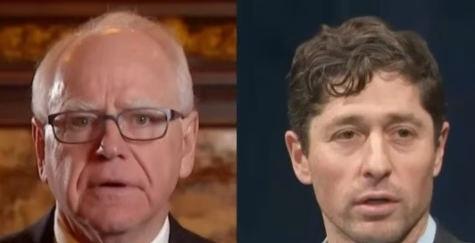
What started as street unrest in Minneapolis is now colliding with federal law enforcement and the Justice Department itself. After days of escalating protests,, two shootings, one death and a dramatic takedown scene that exposed visible tension between city leadership and police, CBS News is now reporting that Minnesota Governor Tim Walz and Minneapolis Mayor Jacob Frey are under federal investigation over whether their words and actions interfered with federal immigration enforcement. This is no longer just a riot story. It is now a federal authority story.
Minneapolis Clashes Move From Streets to the Justice Department
CBS News reported Friday that the Justice Department has opened a federal investigation into Minnesota officials over what is being described as an alleged conspiracy to impede federal immigration agents. According to CBS, both Governor Tim Walz and Minneapolis Mayor Jacob Frey are targets of the inquiry, along with others.
“CBS News has learned the Justice Department is investigating Minnesota officials over an alleged conspiracy to impede federal immigration agents,” the network reported. “Governor Tim Walz and Minneapolis Mayor Jacob Frey are targets of the investigation.”
That development lands just days after violent street confrontations, dramatic arrests, and growing concern that protests were shifting into something more coordinated and more dangerous.
What Federal Officials Are Allegedly Investigating
CBS News immigration politics reporter Camila DeChalus said U.S. officials confirmed an active federal inquiry focused on statements and actions made by state and city leaders surrounding the deployment of ICE and Border Patrol agents.
“We are told by U.S. officials that indeed there is an ongoing Justice Department federal investigation into the actions of Mayor Frey in Minneapolis and Governor Walz in Minnesota over statements that they have made over the deployment of ICE and Border Patrol agents in the Twin Cities region,” she said.
The report ties directly to the Trump administration’s massive immigration enforcement surge in Minnesota. According to CBS, the federal government has deployed “upwards of 3,000 ICE and Border Patrol agents” to the region to arrest people suspected of being in the country illegally and to investigate allegations of fraud. CBS described it as “the largest Department of Homeland Security investigation and immigration enforcement operation in the department’s history.”
One federal official told CBS the inquiry centers on a provision of U.S. law that makes it a crime for “two or more people to conspire to prevent federal officers from carrying out their official duties through force, intimidation, or threats.”
That framing marks a serious escalation. It moves the conflict from political disagreement into potential criminal exposure.
Local Leadership and Law Enforcement Were Already at Odds
We reported this morning about the distance between the Police Chief and the Mayor:
This federal development comes on the heels of a highly publicized clash that exposed fractures inside Minneapolis leadership itself. During Thursday’s dramatic takedown scene, Police Chief Brian O’Hara and Mayor Frey gave noticeably different accounts of what happened and why.
O’Hara emphasized crowd control and officer safety. Frey leaned heavily into protester narratives and political messaging. That split mattered because it showed Minneapolis was not operating from a single command voice while federal agents were working in the same city.
CBS acknowledged that both Walz and Frey have publicly called for peaceful protests. But it also noted that both leaders have “heavily criticized the presence of federal law enforcement” and that the region maintains local policies limiting cooperation with ICE.
That combination is exactly what federal investigators are now reportedly examining.
Why This Is a Major Escalation
If federal authorities are truly investigating whether top Minnesota officials crossed from criticism into interference, this becomes one of the most serious immigration related confrontations in years.
This is about whether elected officials used the power of their offices to obstruct federal law enforcement during an active national operation.
That matters for one simple reason. The Constitution does not give mayors or governors veto power over federal law.
States can disagree. Cities can posture. But when federal officers are carrying out lawful duties, organizing or encouraging resistance that crosses into obstruction becomes a federal issue very quickly.
That is why the statute CBS referenced is so important. It does not require violence. It focuses on conspiracy to prevent federal officers from doing their jobs through intimidation, threats, or coordinated action.
In plain language, it asks whether political leadership helped create conditions that endangered federal agents or deliberately undermined their mission.
The Red Flag That Made People Nervous
We reported on the Red Flags of Revolution:
This is also unfolding against the backdrop of footage from last week that disturbed even longtime riot observers. Journalists covering the Minneapolis unrest captured images of coordinated behavior, masked groups moving together, and a man prominently waving a red flag.
That symbolism is not accidental. Historically, red flags have been associated with revolutionary movements, organized agitation, and ideological street campaigns. It stood out because it suggested something beyond spontaneous outrage.
It suggested a structure.
When street unrest shows signs of organization and elected officials are simultaneously condemning federal enforcement, the line between protest culture and political interference becomes dangerously thin.
Why Understanding This Moment Matters
Supporters of aggressive immigration enforcement have long argued that ICE agents are being asked to operate in an increasingly hostile environment. Cities that advertise themselves as sanctuaries. Officials who publicly demonize federal officers. Media narratives that frame enforcement itself as immoral.
All of that filters down to the street.
The Trump administration’s Minnesota operation was not small. It was described by CBS as the largest DHS enforcement effort in the department’s history. That scale brings risk. It demands coordination. It requires political leaders to lower the temperature, not inflame it.
If federal investigators believe local officials did the opposite, that becomes a constitutional confrontation, not just a political one.
The country has watched for years as riots, protests, and federal enforcement collided. What is different now is that the Justice Department itself is reportedly stepping in to examine whether those clashes were influenced from the top.
This is no longer only about what happened in the streets of Minneapolis. It is about whether the rule of law can function when political leaders openly oppose federal operations.
The answer to that question will echo far beyond Minnesota.
And the fact that it is being asked at all should tell Americans how serious this moment has become.