
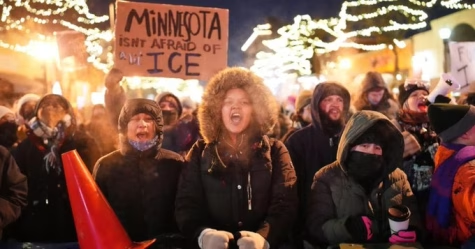
After a weekend of violent unrest in Minneapolis, the central question is no longer whether people have the right to protest. It is why some participants are still choosing confrontation when the situation has escalated to federal deployments, deadly force incidents, armed autonomous zones, and active crime scenes.
Resource for this article:
“Main character syndrome is the perception that your life is a story or a movie where you’re the central character. A term that was born on social media, it’s not a true syndrome or mental disorder. But it may overlap a bit with a handful of mental health conditions. Main character syndrome is also referred to as main character energy.
When you see yourself as the star or protagonist, you may behave as if you always have an audience. Of course, most everyone acts a bit differently when they know – or believe – someone is watching. But that behavior is magnified when you have main character syndrome. It’s not who you really are, it’s the image you want to create for others,” according to WEBMD.
WATCH THE DRAMA UNFOLD:
When flashbangs, tear gas, and National Guard units are in the streets, this is no longer symbolic dissent. This is a high-risk conflict environment. At that point, the rational response for anyone claiming to care about community safety should be to disengage and go home.
Yet many did not. Instead, crowds surged toward federal officers, rebuilt barricades, screamed at agents to kill them, and framed the scene as a revolutionary drama. Minneapolis is now a case study in what happens when protest culture collides with federal law enforcement authority and refuses to yield.
An Embattled City Meets Federal Power
Minneapolis entered the weekend already under strain, with local leadership politically weakened and public trust fractured. Into that atmosphere came a sharp federal escalation: ICE operations, DHS deployments, and what federal officials have described as a surge operation tied to arrests and investigations.
By Sunday, footage from national and independent outlets showed a cityscape that looked less like a demonstration and more like a security zone. Flashbangs echoed. Tear gas clouds drifted across commercial streets. Federal buildings were ringed by agents. National Guard units were positioned. Residential neighborhoods were not spared from crowd-control tactics.
This was not a protest march. This was a federal operation unfolding in real time, with an agitated crowd pressing against it.
From Protest to Autonomous Zone
One of the most alarming developments was the attempted creation of what participants openly called an “autonomous zone.” Barricades were constructed from dumpsters, pallets, and materials taken from nearby businesses. Makeshift borders went up. Livestreams showed people organizing space, directing movement, and warning others when law enforcement approached.
Inside that zone, livestreamers reported threats and physical attacks. At least two individuals armed with visible weapons were seen on camera. Signage invoking violence and “Kill Nazis” rhetoric appeared. The tone shifted from protest to territorial defiance.
By Sunday, law enforcement dismantled parts of these barricades. Protesters responded by trying to rebuild them, screaming insults at officers and surging forward as federal agents pushed back.
This is the moment where the question becomes unavoidable: why stay?
“You’re Going to Have to Kill Me”
Footage circulating from Sunday captured a protester screaming at federal officers, “You’re going to have to kill me,” as tear gas was deployed and the crowd advanced. Other videos show people yelling “Back to the front” and “Youth to the front,” language that mirrors organized street confrontations rather than spontaneous protest.
These are not the words of people seeking reform through civic pressure. They are the words of people framing themselves as characters in a battle.
Woman watches an gets hysterical as her husband is arrested by Feds:
When a woman used a loudspeaker to ask the crowd to give the FBI space to investigate a shooting site, her voice was nearly drowned out by rage from those around her. One federal agent, caught on an open mic, was heard saying something close to disbelief: “My gosh, this is crazy… all for freedom, I guess.”
That remark cuts to the heart of the issue. At what point does the performance of “freedom” become indistinguishable from chaos?
The Deadly Reality of Escalation
This weekend was not theoretical. It was lethal.
Reports confirmed multiple shootings connected to attempts to arrest suspects, including at least one fatality. That fact alone changes the moral terrain. Once firearms are involved and people are dying, every additional person who presses into that environment is gambling with their life and the lives of others.
No slogan can override that reality. No chant negates the authority of federal agents executing warrants. No autonomous zone protects bystanders when armed individuals and flashbangs share the same few city blocks.
At that stage, staying is not protest. It is participation in a volatile enforcement operation.
Sanctuary Rhetoric Meets Federal Authority
Adding to the tension was a high-profile letter from Attorney General Pam Bondi signaling a federal challenge to sanctuary policies. Protesters repeatedly claimed they were “protecting their community.” Federal authorities, meanwhile, continued arrests and operations, asserting jurisdiction and supremacy under federal law.
This clash between sanctuary rhetoric and federal enforcement power is not abstract. It plays out on pavement, through gas masks, shields, and handcuffs. And federal law is unambiguous on one point echoed recently by Chicago’s police leadership: federal agents are law enforcement officers. Interfering with their duties is a crime, regardless of political feeling.
Minneapolis leadership’s relative silence compared to that clarity has left a vacuum, one now filled by street mobilization and federal command structures.
The Myth of the Main Character
What stood out most in the weekend’s footage was not just anger, but theater. Participants spoke in moral absolutes. Nazi analogies were shouted. Homemade signs framed violence as virtue. Some appeared to believe they were protagonists in a cinematic struggle against evil.
But federal law enforcement does not operate inside narrative fantasy. It operates through arrest teams, evidence protocols, and crowd-control tactics. When people step into that machinery imagining themselves as heroes, they are not resisting a story. They are colliding with a system designed to overpower them.
That collision rarely ends well.
Why Going Home Now Matters
Every escalation narrows the exits. Each rebuilt barricade invites a stronger response. Each thrown object raises the risk threshold. Each armed presence increases the odds of irreversible outcomes.
Going home is not surrender. It is self-preservation. It is refusing to let political passion turn into a permanent injury, a prison sentence, or a death notice.
If the stated goal is to protect community, then the first obligation is to stop turning that community into a battlefield.
Minneapolis does not need more flashbangs. It needs de-escalation, clarity from local leadership, and citizens who understand when a line has been crossed.
This weekend, that line was not just crossed. It was fortified with barricades.
And the longer people pretend they are immune to the consequences of federal authority, the more likely it becomes that the next headline will not be about protest at all, but about funerals.