
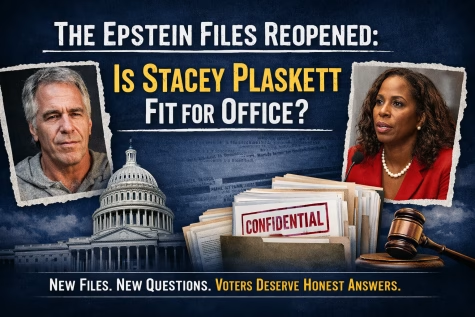
The latest releases of Epstein-related records, in late Jan. 2026, do not establish criminal wrongdoing by Rep. Stacey Plaskett, to our knowledge. They do, however, reopen unresolved questions about her judgment, proximity to power, and the institutional culture of government in the US Virgin Islands (USVI), which Congress itself nearly addressed in late 2025.
Resource for this article:
Republicans fail to oust Plaskett from House Intel in shock vote
Revisiting those questions now is the responsibility of good journalism in a self-governing society to present the full record so voters can decide what kind of leadership they want.
Why This Is Being Revisited Now
The renewed focus on officials, like Democrat US House Rep. Stacey Plaskett, who interacted with Jeffrey Epstein, comes amid ongoing releases of previously sealed Epstein files, which continue to reshape how Epstein’s post-conviction relationships are evaluated.
While many of the underlying interactions were reported years ago, the expanding documentary record has changed the context. What once appeared as isolated episodes are now being reassessed as part of a broader pattern of access, normalization, and institutional failure.
That reassessment is not speculative. In November 2025, the U.S. House itself nearly acted.
As reported by Axios, House Republicans brought a resolution to censure Rep. Stacey Plaskett and remove her from the House Intelligence Committee over Epstein-related communications. The measure failed narrowly, but it reached the House floor an extraordinary step that underscored the seriousness of the concern, even absent proof of illegality.
Congress did not exonerate Plaskett. It simply did not reach the threshold for discipline.
That unresolved outcome is precisely why responsible journalism revisits the record when new context emerges.
Plaskett’s Role in the Epstein-Era System
Court transcripts from a February 12, 2009 public hearing of the U.S. Virgin Islands Economic Development Commission show Plaskett participating as commission counsel during deliberations over tax benefit extensions for Epstein’s company, Financial Trust Company Inc.
In that hearing, Plaskett clarified legal boundaries and corrected the record regarding whether the Attorney General had ruled on benefit extensions. Her role was procedural, not promotional. The transcript does not show her advocating for Epstein, negotiating benefits, or concealing information.
What it does show is something more subtle and more consequential: a governing system that continued to treat Epstein as a legitimate economic actor even after his criminal conduct was publicly known.
That system included lawyers, commissioners, and elected officials operating within established incentives and norms. Plaskett was part of that institutional environment.
That distinction matters. Journalism’s role is to describe systems accurately, not to manufacture villains.
From Government Counsel to Congress
Years later, after Plaskett became the U.S. Virgin Islands’ delegate to Congress, Epstein supported her campaign financially.
A 2018 fundraising email exchange shows Plaskett requesting that an invitation be shared with Epstein and expressing gratitude for his support. The exchange accurately describes federal campaign contribution limits in effect at the time. The contributions were legal, and Plaskett later stated she donated Epstein-linked funds to charity.
There is no evidence in the public record that the donations were tied to any official act.
Again, the issue is not legality right now. It is judgment.
Journalism does not exist solely to identify crimes. It exists to help citizens evaluate whether public officials exercised sound judgment in situations that test public trust.
The 2019 Text Messages and the Congressional Flashpoint
The most politically damaging episode emerged in connection with text messages exchanged between Epstein and Plaskett during a 2019 congressional hearing.
Those messages reported by major outlets and central to the 2025 House censure effort raised questions about real-time communication between a member of Congress and a convicted sex offender during official proceedings.
Supporters argued the messages did not influence her actions. Critics argued the mere fact of the communication crossed a line.
Congress weighed those arguments and stopped short of removal. That outcome left the issue unresolved rather than settled.
What the Epstein Files Change and What They Do Not
The newly released Epstein files do not retroactively criminalize conduct that was legal at the time. They do not establish bribery, coercion, or trafficking-related complicity by Plaskett as this point.
What they do change is the evidentiary density around Epstein’s relationships.
As more documents surface, journalists are obligated to reassess:
- Who maintained contact with Epstein after his conviction
- In what capacity those contacts occurred
- Whether institutions applied consistent standards of judgment
This is about transparency.
Journalism’s Role in a Self-Governing Society
In a democracy, journalists are custodians of the public record.
The standard is not “prove a crime” but “provide voters with enough information to evaluate trust, judgment, and leadership.”
Revisiting Stacey Plaskett’s record in light of the expanding Epstein files meets that standard:
- It relies on primary documents and on-the-record reporting
- It acknowledges where evidence falls short
- It distinguishes institutional failure from personal criminality
That is what ethical journalism looks like.
The Question Before Voters
The Epstein files have reopened a broader question that extends beyond any single official:
Should leadership be judged solely on legality, or also on judgment exercised in morally compromised environments?
Congress came close to answering that question in 2025 and stopped short.
Journalism’s role now is not to answer it for voters but to ensure voters can answer it for themselves.
That is how good government is chosen.